
Shelter and street animals
What your animal brought with it
An animal that comes from a shelter or from the street carries a history nobody fully knows. Some of it only shows weeks or months later, once the first shock has passed and the animal dares to show anything at all.
Then the cat pees beside the litter box although the vet finds nothing. The dog bolts his food as if it were about to be taken away. Someone picks up a broom and the animal is gone. Or nothing conspicuous happens at all – there is just a distance that will not close.
This is exactly where my work sits: with animals whose behaviour today comes from what happened before.
Where this comes from
Not out of a textbook
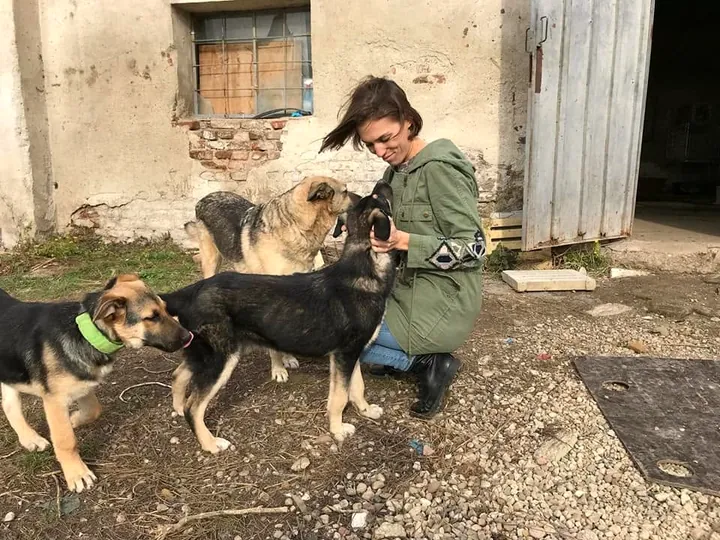
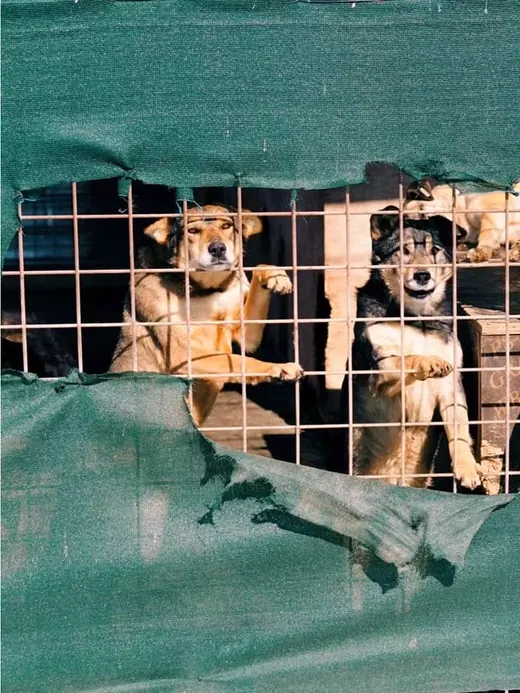
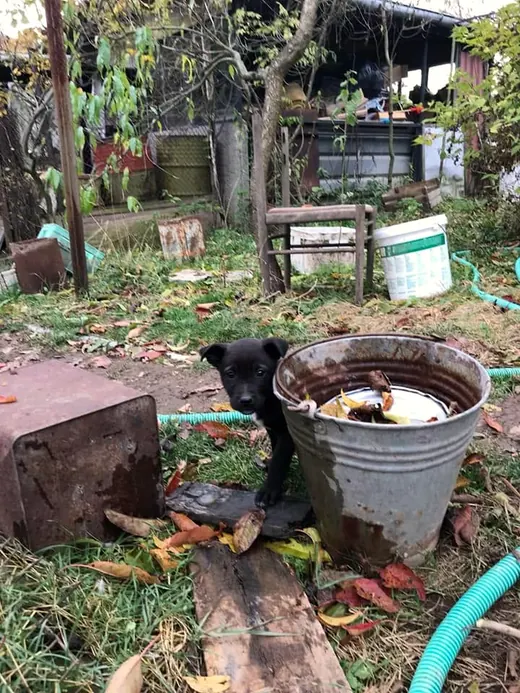
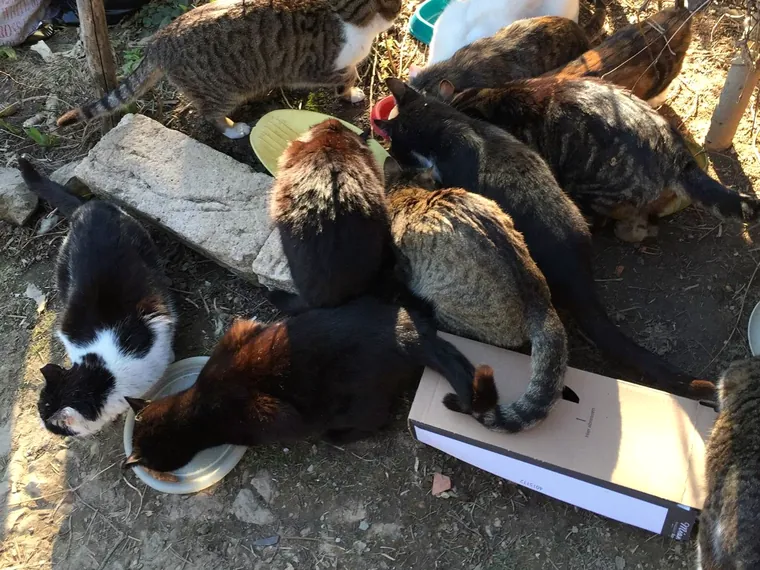
Since 2014 I have volunteered for Streunerhilfe Bulgarien, a stray animal charity. In Austria I am part of the cat rehoming team – so I know these animals before they reach their people, and I hear how things go once they are there.
A few times I have flown out myself. The pictures on this page are from those trips.
How you notice it is about the past
There is no list that fits every animal. These patterns, though, I see particularly often in animals with a hard history:
Soiling although everything is physically fine
Often it is not about the box but about its place: too open, too loud, too close to something frightening. Sometimes it is a boundary the animal draws because it sees no other way.
Everything around food
Bolting, guarding, hoarding, endless begging. An animal that has gone hungry does not stop being hungry just because the bowl is full every day now.
Fear of one particular thing
Of men, of brooms, of the car, of stairs, of certain sounds. Almost always something hangs on it that you know nothing about.
Not being able to stay alone
An animal that has been left behind once expects it again. That is not a training question.
Freezing instead of reacting
The quietest pattern and the easiest to miss. An animal doing nothing is often not relaxed but waiting.
When to see a vet first
Not for everything. A dog who bolts his food and a cat who vanishes at the sight of a broom do not need an examination – those are learned things, nothing is broken physically.
For these four, though, please see a vet first, whether or not we later talk to each other:
Soiling in cats
Very often something physical is behind it – cystitis, crystals, pain on crouching. That belongs checked before anything else is considered.
When something changes suddenly
An animal that has done a thing one way for years and does it differently from one week to the next usually means the body, not the past.
Anything that looks like pain
Getting up differently, avoiding stairs, no longer wanting to be touched, flinching at contact, chewing only on one side.
Animal communication replaces neither veterinary treatment nor behaviour therapy. It comes in alongside – once the physical side is clear, or beside it if you are already in treatment.
How I work with that
I ask your animal how it experiences the matter. Not to move it towards some behaviour, but to understand what that behaviour is good for. Almost always there is a reason behind it that makes sense from the animal's point of view.
What comes out of that I write down for you in detail, together with what can take hold in daily life:
Understanding
The first and often biggest step. Many people treat their animal differently the moment they know what it is actually about. Sometimes something shifts through that alone.
Rituals for both of you
A fixed sequence that stays the same every day – at feeding, when coming home, before the night. Animals that never knew what came next are calmed more by repetition than by any amount of stroking.
Changes in the room
Where the box stands, where the animal sleeps, from where it can survey the room, where it can withdraw without feeling cornered. Often these are small things that cost nothing.
Gestures
A particular way of announcing yourself. A word before you enter the room. Looking away instead of looking at. Animals read us very closely – and respond to what we do unconsciously more strongly than to what we say.
You do not need to be present. I hold the conversation during the agreed day and you get your written record afterwards. This works independently of location; your animal stays home in its familiar surroundings.
What I do not promise: that a behaviour disappears. An animal that lived on the street for years does not become a different one in a week. What usually changes is how it is handled – and with that, often the behaviour itself.
When you are ready
Book a soul conversation
Pick an open day. I confirm the appointment personally, then you send me a photo and a few details about your animal. On the agreed day I hold the conversation and write down for you what came out of it.
€120 for a soul conversation. The other prices are on the home page under services.
To the open daysIf you are unsure
Write to me first
If you do not know whether this is the right thing for the two of you, describe briefly what is going on. I will tell you honestly what I think makes sense – even if that means something else is due right now.
Write to meWhat people with rescue animals ask me
The general questions about animal communication – training, process, distance – are answered on the home page. Here it is only about what has to do with a past.
My animal has only been here two weeks. Should I wait?
In most cases yes. The first weeks are an exceptional state in which it is not yet clear who this animal actually is. Give it a few weeks of ordinary life. It is different when something is genuinely difficult from the start – then do get in touch straight away.
I know nothing about my animal's past.
With rescue animals that is the normal case, and it is no obstacle. I ask the animal, not the file. What you know helps me place things – it is not needed.
Won't a conversation like that stir my animal up?
I do not force any animal to look anywhere. If one does not want to talk about a thing, I leave it standing and write that down as it is. Animals decide for themselves how far they go – usually further than you would expect, but willingly.
I am sure I did a lot wrong. Will that come up?
If your animal brings it up, I write it down for you – without reproach, because from the animal's point of view there is none. What I hear far more often with rescue animals is the opposite: that they notice how hard their person is trying. You do not have to confess anything to me.
What if nothing about the past comes through?
That happens, and I do not invent anything to fill the gap. Often it is the more useful answer: it is not about back then but about something here and now – a sound, a place, another cat in the house.
We have several animals and it grates between them.
Then it is worth talking to both, not only to the one who stands out. Very often one is reacting to something coming from the other. Write to me about your situation and I will tell you what I think makes sense.
Will the behaviour then go away?
I do not promise that. An animal that lived on the street for years does not become another one in a week. What usually changes is how it is handled – and with that, often the behaviour itself.
If you have just taken in an animal, there is a page on the first weeks and which rituals carry from the very beginning.

Tell me what is going on
You do not have to decide right away. Write to me about what is difficult for you at the moment – I will come back with an honest view of what I think the next step should be.
Write to me